Methodology
HISTORY OF THE COMMITTEE OF THE IPA INTER-REGIONAL ENCYCLOPEDIC DICTIONARY OF PSYCHOANALYSIS (IRED)
Initially the Task Force 2014-2021, the IRED became a permanent structure of the IPA as the Committee in 2021.
By Eva D. Papiasvili
Chair of IRED since 2021
(Updated January 2025)
PART I
Initial Phases of the IPA Encyclopedic Dictionary – Formation of the Intraregional Consulting Teams and Selection of the Concepts
1. Mandate of the IPA Board
2. Appointment of the regional Co-Chairs, finalized in Spring 2014
3. First GoToMeetings with the IPA President, (founding Chair of IRED during 2013-2021) Vice-President, and the regional Co-Chairs. (Electronic meetings continued throughout the years on ZOOM as IRED Committee Meetings, with the Chair, Co-Chairs and 1-2 consultants to the Committee per region.)
First we discussed and made decisions on following subjects:
- Grassroots Selection of Concepts
a) Enlisting of the regional Consultants:
Each of the Co-Chairs enlisted 20-25 prominent Consultants within each of the three IPA psychoanalytic cultures, representing the diverse schools of thought and diverse intra-cultural geographies.
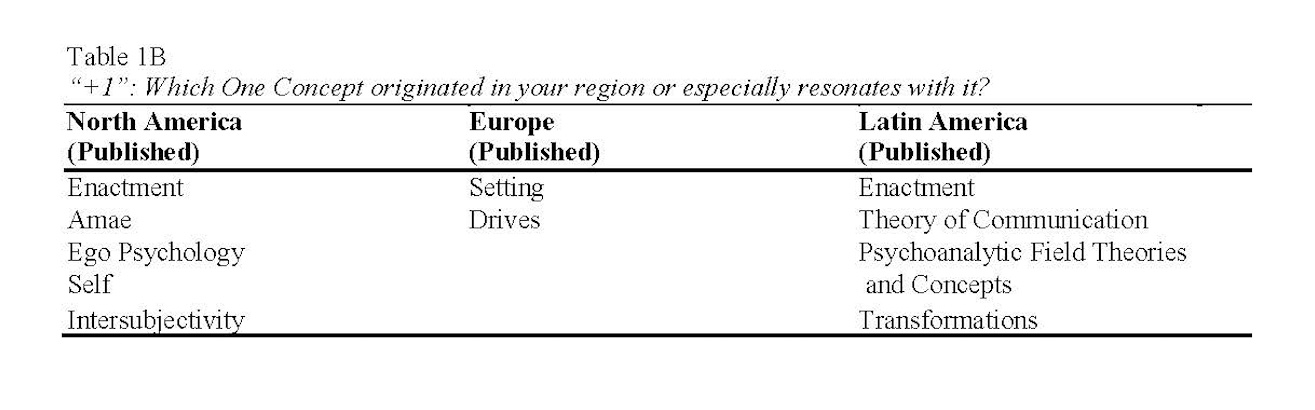
b) - Identifying the global and regional concepts most relevant to today’s psychoanalytic thought and clinical work: based on the so-called “5+1”: we asked the Consultants individually two questions: “Which five psychoanalytic concepts inform your thinking and clinical work most?”, and “Which concept do you feel either originated in your (European/Latin American/North American) psychoanalytic culture, or has a special resonance with it?” Based on the answers, we identified the 5 general concepts and 1 regionally-specific concept within each region, which occurred most frequently. Then we proceeded to identify the 5 most general concepts occurring most frequently on a global scale. These were: TRANSFERENCE, COUNTERTRANSFERENCE, UNCONSCIOUS, PROJECTIVE IDENTIFICATION and CONTAINMENT. The most frequently mentioned regional concepts were TRANSFORMATION for Latin America, SETTING for Europe, and ENACTMENT for North America. These were the first to start writing on. It soon became apparent that each region had its own dynamic process surrounding such selections, and its own interaction between the general and regionally-specific conceptual base.
- Continuing IDENTIFICATION of NEXT FREQUENTLY OCCURRING CONCEPTS to write
Based on the frequency of concurrence of answers in at least two continents, the Co-Chairs agreed, in the face-to-face meeting in Madrid, on the next round of concepts. These were CONFLICT, NACHTRÄGLICHKEIT, and OBJECT RELATIONS. In the same way, the Co-Chairs agreed, in the face-to-face meeting in London, on the following group of most frequently mentioned general concepts: FREE ASSOCIATION, REGRESSION, INTERNALIZATION, REPRESENTATION, and SYMBOLIZATION.
Additionally, regionally specific DRIVE(S) was proposed frequently in Europe, SELF, INTERSUBJECTIVITY, EGO PSYCHOLOGY, and AMAE in North America, and PSYCHOANALYTIC FIELD THEORY AND CONCEPTS, and THEORY OF COMMUNICATION in Latin America.
At this stage, we also encountered surprises. For instance, it came out that both North and Latin America chose ENACTMENT as a regional concept, and therefore, both have written original drafts; both have been bi-regionally collated into a bi-regional draft and sent to Europe for the Response draft.
Going forward, the idea was to gradually get to all the concepts mentioned in all three continental cultures. (See Tables 1, 2 below).
The conceptual ideas were being clustered, according to the common roots, e.g. Self Objects, Object Relations, Narcissistic Object, Use of the Object, Part Object, Transitional Object, Internal Object Relations, Maddening Object and others were all being clustered under “Object Relations Theories”, which then became the heading of the entry for the Inter-Regional Encyclopedic Dictionary of Psychoanalysis.
Once the most frequent clusters/headings of prospective entries were being determined, the regional teams were formed out of those Consultants who mentioned the concept in their responses to the above mentioned questions.
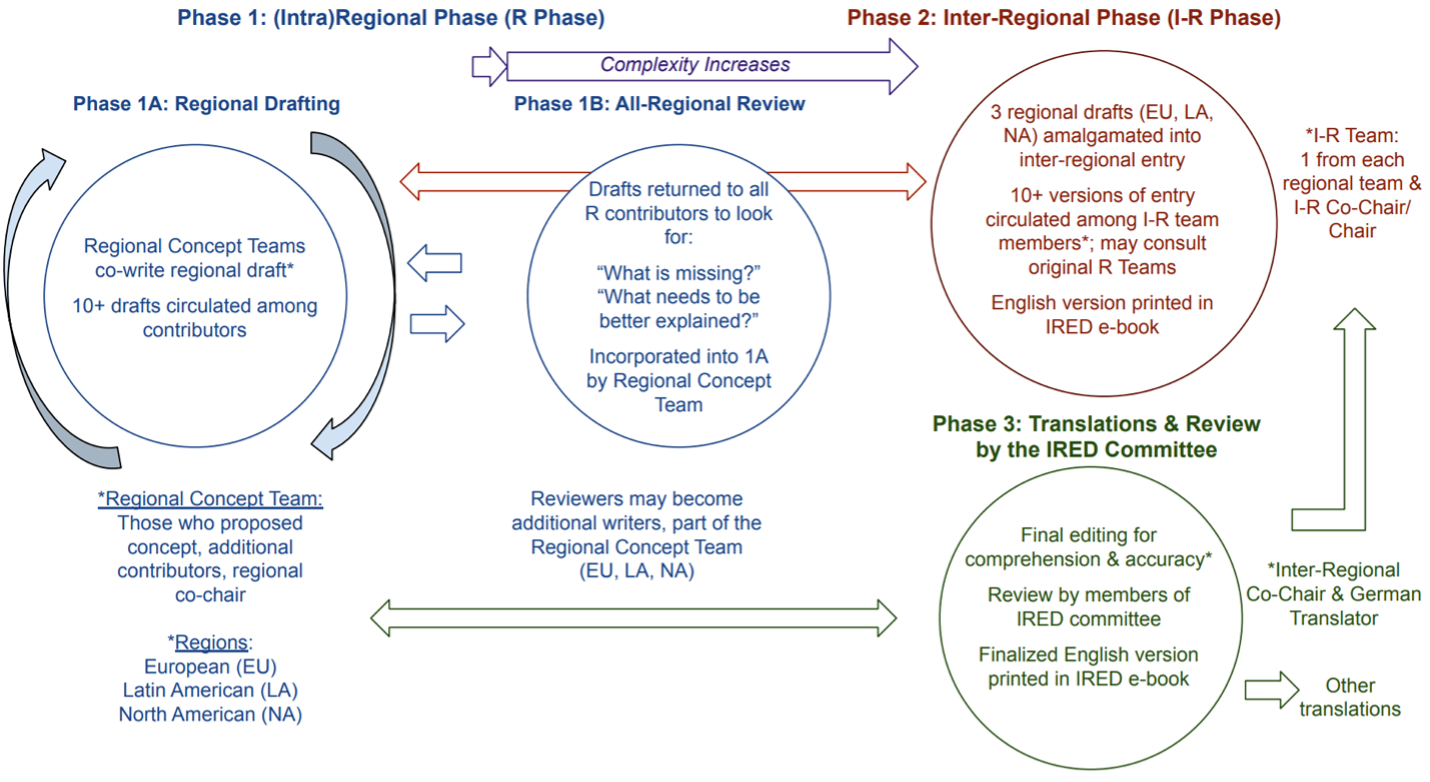
- The feedback driven MULTIPHASIC METHODOLOGICAL PROCESS that developed consisted of Regional Phase, (A, B, C below) and Inter-Regional Phase (A below and section II)
A. Definition of the basic FORMAT OF THE CONCEPT ENTRIES
1. depending on the length of regional drafts, the inter-reginal (tri-regional) entries’ length varies, anywhere between 12 pages (AMAE) and 80 (EGO PSYCHOLOGY) in English original.
2. regional drafts and tri-regional entry outline: contains Dictionary parts (Introductory Definition, Conclusion sections) and Encyclopedic parts (Concept’s pre-analytic and analytic roots/history, its evolution and current usage within each continental culture; inter-disciplinary studies, where pertinent, and references, etc).
B. INTRA-REGIONAL TEAMS writing CONCEPT DRAFTS
The answers led to the creation of the 2-5 member concept teams of Consultants, who mentioned the same concept in their original responses to the two questions above. Writing the regional concept draft, Consultants had a choice to enlist additional writers/advisers, specialists on the concept, according to the need. This way we proceeded writing on TRANSFERENCE, COUNTERTRANSFERENCE, THE UNCONSCIOUS, PROJECTIVE IDENTIFICATION AND CONTAINMENT together, while each region also pursued writing their regionally-specific drafts: SETTING for Europe, ENACTMENT for North America and TRANSFORMATIONS for Latin America.
C. INTRA-REGIONAL REVIEW PROCESS
Once the concept teams were finished with the regional draft, the whole pool of Consultants within each region reviewed the draft, responding to two questions: 1. Is anything missing? and 2. Does anything need to be better/more comprehensively explained? The intra-regional review resulted in comments for the concept team to implement. . The intra-regional review resulted in comments for the concept team to implement.
PART II
METHODOLOGY OF THE INTER-REGIONAL WORK
INTERREGIONAL TEAMS writing TRI-REGIONAL CONCEPT ENTRIES
When the conceptual drafts from each region are finished, an interregional team consisting of one member of each regional team responsible for a particular concept is formed to write the final tri-regional IRED entry of each concept, to be published in the IRED e-Book. Final entries are approved by the IRED Committee, which includes the Global Chair, Regional Co-Chairs, and 1-2 Consultants to the Committee per region, to be published first on the IPA website.
Inter-regional Entries are constructed with the active coordination and guidance of the inter-regional Chair or Co-Chair, whose coordination work includes:
1. Reviewing the Regional Drafts. (In case of bi-regional work, the process of its construction will be the same with the two original drafts, as with multiple drafts below.) If the Co-Chair finds major omissions, it is the Co-Chair’s discretion to request the inclusion/expansion of the entry, with as specific instruction as possible for how to rectify the omission. In this case, the specific parameters (additional time needed, etc.) are agreed on.
2. Sending all pertinent Drafts (three original Regional Drafts, or the Bi-regional Draft and one Response Draft, or One Original Draft and two Response Drafts) to the three inter-regional Consultants.
3. Providing a clear instruction of the objectives and the overall outline of the Inter-regional Entry. In this way, the Co-Chair functions as a ‘guide’ who is familiar with the overall vision, map of the Encyclopedic Dictionary, being aware of the methodology, other entries and the overall process.
4. Throughout, the Co-Chair is involved as a guide in the gradual work of merging the drafts, and responds to specific needs to help structure the inter-regional entry (what, how and where to include, e.g. ‘bridging statements’, ‘translating’ between different styles of regional drafts, helping to see if anything is missing, etc.). The specific manner and the extent of the Co-Chair’s guiding involvement varies, according to the needs of the particular inter-regional team.
5. It is the Co-Chair’s responsibility to assure the mutually respectful and inclusive atmosphere.
OUTLINE OF THE INTER-REGIONAL ENTRY
The basic principle here is that nothing of substance of the content of the previous (bi) regional drafts is left out. (In case of dealing with the combination of previous Bi-Regional Draft and a Response Draft, the content of the Response is incorporated into the pre-existing Bi-regional Draft, in consultation between the 3 regional Consultants and the inter-regional Co-Chair. If the Response includes requests for further clarification/explication/addition of content, this will be considered. (The requests for shortening/excluding/subtracting of any kind, are not considered appropriate.)
As to the style, as it relates to the content: it is understood that different regions are writing in different styles. This is to be treated as an asset: e.g., the more general style of one region may be used to outline the basic contours, which will be enriched by specifications provided by the writing of another region. As these may need to be collated in a way that accurately represents the factual input from all regions, the final style of the inter-regional entry will be by definition a different style than the one of any of the previous regional concept drafts. Outright redundancies can be minimized during the tri-regional work. Technical parameters of style include: using ‘Third person voice’, not ‘first person voice’: e.g. not “we/I think…”, but “Such and such author thinks…” or “In opinion of many…”, etc. The literature in the text and in the chapter References is to be in the IPA/APA style, and all regional References are merged and alphabetized. Cross-referencing with other concepts may be a matter of knowledge of the Co-Chair, who is familiar with other inter-regional concept work, and is to be included in parentheses, e.g. (See also a separate entry COUNTERTRANSFERENCE.) The accuracy of English wording may be in the end the responsibility of English speakers; in some cases, additional consultation/editorial assistance may be sought by the Co-Chair. Throughout the process, the Co-Chair or individual members of the inter-regional team may ask for a consult regarding content or editorial matters, depending on the specific issue, from anyone on their regional team; the other region’s Co-Chair; any Consultant within their region or any IPA region, or any other expert in the specific area.
OUTLINE:
A. Introduction; Introductory Definition
All regional definitions are to be represented. Here, the contemporary definition(s) of the core concept, which may be extrapolated from the recent regional dictionaries, may be followed by a short introductory overview of the evolution of conceptual definitions through time. These may vary according to the regions; in the cases of such variance, the variability is to be preserved and all definitions, documented by recent regional dictionaries wherever applicable, are to be included; possible comparative statement(s) may be added.
B. Historical review of the ‘general’ evolution of the core concept
This may include the “historical precursors” (what previous concepts may have contributed to the particular concept’s inception), as per any/all of the previous drafts. This chapter is to be written as a collation of regional Historical review chapters, in a chronological unified way. The descriptions and explanations may be exemplified by citations of the original authors of the core concept. Regional differences in the approach to history may be noted. (General History chapters are always part of the Original Drafts, but it is optional for the Response Drafts, according to the specific position of a specific concept within the region that writes the Response Draft. By definition, the Response Draft is coming out of a region where the concept does not occupy such a central position, as in the regions that wrote the Original Drafts.)
C. Further evolution of the concept, within different regions and within different theoretical perspectives, including any/all of the material from the previous regional drafts.
D. Recent/contemporary theoretical developments and clinical applications, specifically in different regions, as per all previous drafts. Clinical uses and illustrations of the concept are given as a set of generalized principles, steps, etc., not as case vignettes.
E. Optional – Inter-Disciplinary Studies, where pertinent.
F. Conclusion – Summary (Including the substance of summaries of the previous drafts; then possibly additional co-joint more general summary, coming out of the inter-regional work.)
G. References: Merger and alphabetization of all regional References Chapters; IPA/APA style; S. Freud’s work is to be cited as the Freud, S. (original year of publication). Name of the book, paper. SE Volume in Arabic numbers: pages, if not the full volume. If there is a factual reason to reference the original German publication, then proceed analogically with GW. This is analogical to all original translated and untranslated authors and publication as it pertains to any concept.)
H. Regional Consultants and Contributors to the Regional drafts
(EU, LA, NA team members with their academic degrees). From 2017, once the E-Book in several languages was in the process of publication, the regional consultants and contributors became Regional and/or Inter-Regional “Editorial Board Members”.
Further questions and concerns about any of the above, arising specifically within any inter-regional work are to be referred to the Inter-regional Co-Chair, who will consult with other Co-Chairs and the IRED Committee, if necessary.
In general: While the specific application may differ to some extent from concept to concept, the guiding principles of the methodology are to fulfill the Objectives of the Encyclopedic Dictionary:
COMPLETENESS, RICHNESS, FULL REPRESENTATION
This translates operationally into: IF IN DOUBT, ERRING ON THE SIDE OF INCLUSION, to preserve all the variability of regional inputs. The challenge here is: HOW TO BEST INCLUDE, so that the final entry is comprehensible, NOT IF TO INCLUDE. The principles of conciseness and parsimony are not to be applied at the expense of the Completeness, Richness and Full representation.
PART III
TRANSLATIONAL and PUBLICATION PHASE
After each tri-regional entry has been finalised in English, it is printed electronically in the IRED e-Book.
The coordinating Chair or Co-Chair then goes over the whole entry with the German translator to finesse the language into most comprehensible and accurate ‘translation-ready version’. This process includes final checking of the accuracy of the quotes, references and terminology. This finalized text replaces the first English version, which is then translated into the three official IPA languages by professional translators (German, French and Spanish). Additionally, IRED has been translated gradually into 10 languages by volunteer translators-analysts; These include Italian, Portuguese, Traditional Chinese, Classical Arabic, Hebrew, Iranian/Farsi, Japanese, Russian, Serbian and Romanian. Languages.
The following Tables 1A and 1B portray the results of the grassroots selection of concepts, using a/the “5+1” method. Table 1A reflects the most frequently mentioned general concepts in response to the question written above the table. Table 1B reflects the most frequently named regional concepts, in response to the question above its table.
Table 1 A: General Concepts
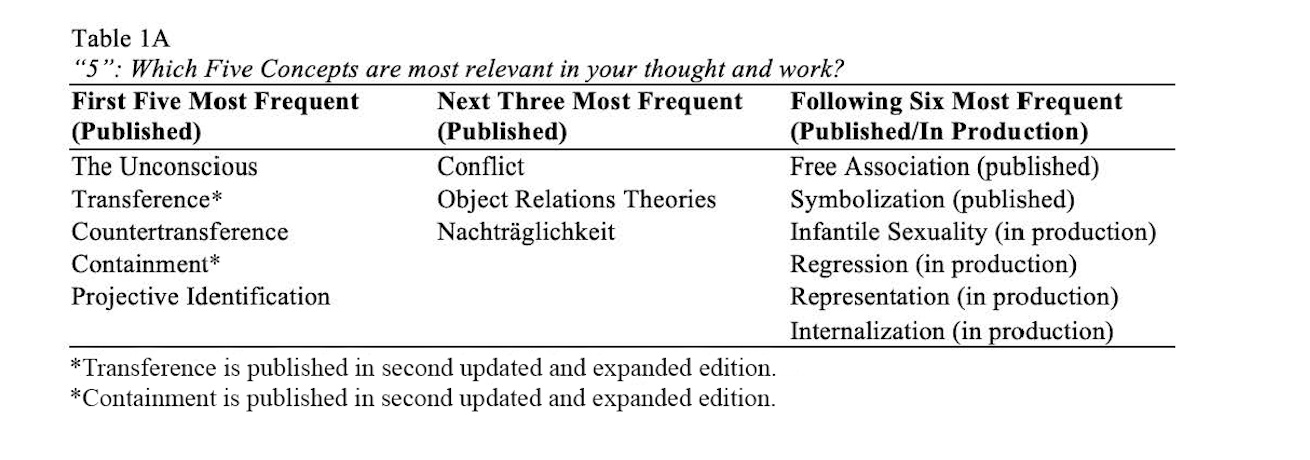
Table 1 B: Regionally Specific Concepts
Feedback-driven multi-phasic methodological process which follows the selection of concepts is graphically portrayed below.
Graph: Process of Collaborative Construction of Tri-Regional Entries
The Tables and the Graph were constructed by Eva D. Papiasvili, with the technical assistance of Ilana Gratch.