History of Psychoanalysis Committee
In July 2015 the IPA board approved the establishment of the History of Psychoanalysis Committee. The then IPA President Stefano Bolognini appointed Ludger Hermanns to chair the committee in the beginning of 2016 and two members of each region were appointed to the committee. Soon thereafter, several consultants joined the Committee.
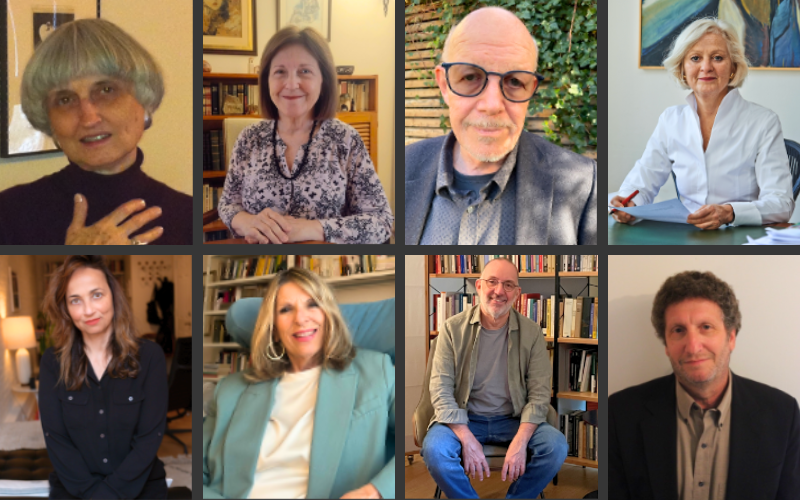
The current members are (pictured left to right): Nellie Thompson (chair), Marcela Bouteiller, Marco Conci, Eveline List, Orna Ophir, Adriana Ranacciotti, Eran Rolnick, and Louis Rose. Ludger Hermanns (not pictured) still consults to the committee to this day.
Meetings were held online with lively discussions about our tasks. A bibliographical project was started and we collected the annual literature in the field of history of psychoanalysis in the various languages of IPA membership. They were finished in English, German and Spanish in the following years and sent to IPA to be published on its website. For the first three years this work was funded by the IPA budget. This support later stopped because of lack of funds.
For IPAC 2017 at Buenos Aires we proposed three panels with topics from our field. One was accepted and enjoyed good reception (Pasando la Antorcha: Migraciones de Psichoanalisis en América Latina).
At the London IPAC 2019, on July 24th’ we organized a very successful Pre-Congess Panel on Psychoanalytical Archives. We cooperated with the Freud Legacy Task Force IPA. Jan Abram and Ewan O’Neill delivered a paper on the archives of the British Psychoanalytical Society, Jane Milton spoke on the Melanie Klein papers deposited at the London Welcome Collection, Carol Seigel delivered remarks about the Freud-Museum London; Thomas Aichhorn described the Psychoanalytical Archives in Vienna and Nellie Thompson reviewed the Archives and Special Collections of the New York Institute’s A.A. Brill Library, she also read a paper by Lou Rose, which addressed the relationship between the Sigmund Freud Archives and the Freud Collections in the Library of Congress. This event was a highlight of the cooperation among different psychoanalytic archives and was enthusiastically received by researchers in the field.
On February 8th & 9th, 2020, our committee was a co-organizer, along with two German psychoanalytical societies the DPV and DPG, of an International Conference, “100 Years of Psychoanalytic Training (1920-2020)”, celebrating the Centennial of the founding of the first Psychoanalytic Institute in Berlin. Speakers came from Europe and both the Americas. Among them were members of our committee, Orna Ophir (New York) and Marcela Bouteiller (Buenos Aires). More than 300 participants enjoyed these brilliant lectures and joined in meaningful discussions of these presentations. All the contributions were published in German in 2021 (Hermanns, L.M., Bouville, V. & Wagner, C. Editors: Ein Jahrhundert psychoanalytische Ausbildung. Einblicke in internationale Entwicklungen, Gießen 2021 Psychosozial Verlag).
This was one of the last international meetings which could take place in vivo before the Covid epidemic, beginning in March 2020, which interrupted in person meetings. During the pandemic the committee’s work continued via digital meetings.
Nellie Thompson was appointed chair in 2022. Following the enthusiasm generated by the London meeting on psychoanalytic archives, and the Berlin conference celebrating the 100th anniversary of the first psychoanalytic institute in Berlin, the History committee began a long-term project to create bulletins devoted to describing the archival holdings of psychoanalytic societies as well as those of independent libraries and archives, e.g. the Library of Congress, in Washington, D.C., and the Wellcome Collection in London.
The intent of the Bulletins is to draw attention to the resources that are to be found in a wide range of psychoanalytic archives and libraries: the personal and professional papers of influential psychoanalysts; documents tracing the origins and aims of psychoanalytic journals and their editors; photographs; memoirs; correspondences; and documents that record both the official, and the unofficial, histories of psychoanalytic Institutes and Societies.
The committee’s first bulletin reprinted, The Sigmund Freud Archives and the Library of Congress: A Psychoanalytic Tale of Two Cities, published in TAP (The American Psychoanalyst). Written by Louis Rose, Executive Director of the Sigmund Freud Archives (SFA) and Jennifer Stuart, President of the SFA Board of Directors. It traces the long and occasionally fractious relationship between the SFA and the Library of Congress. It also highlights an unwavering mutual commitment of both the Library of Congress and the Sigmund Freud Archives to preserve, conserve and ultimately digitalize the Freud Collections.
The committee’s second bulletin was devoted to an account of the Oskar Diethelm Library, part of the DeWitt Wallace Institute for Psychiatry, History, Policy and the Arts, Cornell Medical College New York (WCMC). Nicole Topich, the Diethelm’s librarian, notes that their collections include D.D. Winnicott’s unpublished “correspondence from the years 1957 to 1971, unpublished papers, and an oral interview with Clare Winnicott”. The library also houses the papers of the American Psychoanalytic Association (384 boxes).
Although the committees’ bulletins are envisaged as a resource for scholars and analysts researching and writing on the history, we hope many analysts may be inspired to read some of the books, articles and reviews found alongside the bulletins. Or one may come across what appears to be an interesting article about a subject one has never encountered or considered before. For example, I recently came across a paper published forty years ago, in 1984, by Leon Grinberg and Juan Francisco, “The Influence of Cervantes on the Future Creator of Psychoanalysis”, first presented at the Madrid Congress in 1983. The authors begin by noting that their paper has a special significance for analysts in South America and Spain because it illustrates that there are antecedents of Freud’s thinking in Cervantes’ Don Quixote. Writing as psychoanalysts they find a complexity of feelings and psychic states in Don Quixote that reflect his inner life. In juxtaposing Cervantes and Freud, the authors are drawing attention to their own rich cultural heritage as a point of departure and a pathway for their embrace of psychoanalysis.
Finally, last April the Wellcome Collections in London announced the opening of the papers of the International Psychoanalytic Association (IPA) 1922-2013 for research and study. (The IPA collection consists of 352 archival boxes and includes over 200 uncataloged audio tapes.) This is nothing short of a major development for those whose scholarship and writing is devoted to the study of history of psychoanalysis. As the Wellcome curator, Milen Mistry, noted the IPA papers are “a remarkable global archive that helps to chart the history of psychoanalysis from the early 20th century to the present day.” He goes on to write:
“We see the collection as having great research potential as it opens the door to explore the history of the regional societies and development of psychoanalysis within broader socio-political contexts and world events The archive compliments the Wellcome Collection’s vast holdings relating to the history of mental health.” A final paragraph notes: “The Collection also includes material on the more sensitive and controversial aspects of how psychoanalysis has been governed in the post-war period.”
Lastly, for more information on the IPA archive please see the online catalogue: https://wellcomecollection.org/works/qkcg2y28
Contact information for the archivist: [email protected]
The Wellcome Collection is located at 183-215 Euston Rd, London, directly across the street from the Euston Train station. Finally, The Wellcome Collection is well worth a visit for its museum, exhibits, delicious café and Blackwell’s bookstore.