Little Gifts 2026

In 2026, the IPA in Culture Committee will send you a little gift each month, presenting a cultural expression from different places of the world. It will be something that caught our committee’s attention in regard to a meaningful cultural aspect involved. It will be something to remember, to discover, to further explore or to simply appreciate for a moment.  You can also access our previous little gifts here: 20252024, 2023, 2022, and 2021.

With best wishes from the IPA in Culture Committee
Cláudia C. Antonelli (Chair) 


January
In the northern regions of the world, the Aurora Borealis (as the Aurora Australis in the southern hemisphere) has been regarded as a gathering place: a radiant realm where the visible and invisible worlds converge, inviting observers to marvel and contemplate. Instead of being tied to a specific people or culture, myths and symbols have been created over the centuries to envision what may exist within and beyond the living sky and its cycles: “The dance of ancestors (…)”; “The breath of the universe made visible (…)”; “The pulse of life” — narratives that sustain a connection to the past and honour the ongoing existence of the Universe. These colourful veils elicit people’s silent communication and admiration for this phenomenon that bonds humankind and Nature.

Watch a time-lapse of Alaska's Northern Lights
here.

February
Among many Carnival traditions across the world, usually in February, the Venetian Carnival has its origins in the Middle Ages. It was officially declared a public holiday in 1296; banned in the 17th and 19th centuries, and only recently reinstated, becoming a major, world-famous historical and cultural event. It recovers the tradition of the elegant Italian balls, carrying masks and costumes that now, on the streets, circumvent the rigid rules of society. Its main artefact, however, remains the Venetian mask. Originally, it allowed for the reversal of social roles and the obliteration of differences, especially dualistic ones, such as rich and poor, master and servant, men and women. These masks became a special artefact of the Venetian culture done by great artisans: the mascheri, who developed and perfected clay, plaster, and papier-mâché techniques to create and elaborate the now coveted object that ultimately hides the facial identity, while highlighting the gestures and the unmistakable human gaze.

Watch a video of some spectacular carnival moments
here.

March
The image of Ardhanarishvara serves as a profound illustration of bisexuality, symbolizing the fundamental unity of male and female elements, intrinsic to all human beings. While the concept is rooted in the Natyashastra - the foundational text of Indian aesthetics -, its psychoanalytic significance in India was championed by G. S. Bose, the country's first psychoanalyst. It was Bose who initially discussed the theme of bisexuality and famously initiated the Ardhanarishvara as the official emblem of the Indian Psychoanalytical Society. This choice emerged from his historic dialogue with Freud regarding the resolution of the Oedipal crisis, where Bose offered a distinctively Indian perspective on gender fluidity. Mahatma Gandhi, the Indian leader whose methods of resistance and endurance were mostly rooted in the feminine, is considered by some an important representative of the Ardhanarishvara’s concept.

Photo: Ardhanarishvara, Government Museum, Jhalawar, Rajasthan, India


April
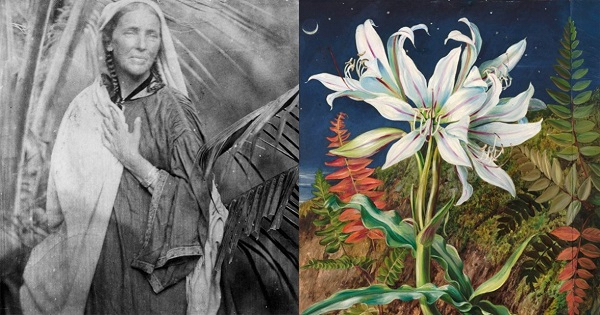
Marianne North (1830–1890) was an extraordinary woman who travelled solo in expeditions to 17 different countries across six continents, between 1871 and 1885, under limited and coarse conditions. She was a painter of plant species, before this became an art in itself. Unlike her contemporaries who used watercolours to paint isolated specimens on white backgrounds, North used oil paints to depict plants in their full ecological context, including surrounding landscapes and wildlife. Following the death of her father in 1869, she used her inheritance to travel to distant locations such as Japan, Singapore, Malaysia, Borneo, Indonesia, Sri Lanka, Ceylon, India, Australasia, New Zealand, South Africa, The Seychelles, Canary Islands, Spain the United States, California, Canada, Jamaica, Chile, and Brazil, alone.  

Because she documented hundreds of species—many previously unknown to Western science—she is also widely regarded as a major pioneer Botanist and plant hunter. Over the course of 13 to 14 years, she created a vast body of work comprising approximately 848 detailed oil paintings. Her meticulous paintings helped document more than 900 plant species. In 1882, she herself funded and opened a dedicated gallery at the Royal Botanic Gardens, Kew (London), to house her entire collection, which remains until this day.


May
Photo: Sebastião Salgado © Exodus

“We have come to call, let's say, Oedipal trauma, neurotic trauma, the trauma of the sexual order, while this other type of trauma, which concerns the recognition of the existence of the person, of the individual, as a subject of desire, we call trauma of the vital order. So, there is trauma of the sexual order and trauma of the vital order. This trauma of the vital order is what we call the effect of cultural trauma.

It is not a matter of dosage, as in the case of Oedipal trauma, in which one renounces the incestuous relationship, in which one partially enjoys the substitute metaphor, which would be the other women to whom one may eventually have access (taking the case of the boy, which is what Freud talked about most). On the side of cultural trauma, the story is different, it is more permanent, it is not a dated threat, which is part of a given moment in libidinal evolution, as in the Oedipal framework. It is permanent. And the fact that it is permanent produces in the subject a similar state of apprehension to what Freud described, in Inhibition, Symptom and Anxiety, as a state of helplessness, as if it were the first time. Why? For a simple reason: the threat to the vital order, the trauma to the vital order, leaves you no escape routes.”

J. F. Costa, Percurso74 Magazine/37/June 2025/p. 126