The Psychoanalytic Education Committee
The Psychoanalytic Education Committee (PEC) was established by the IPA Board to provide guidance on issues of psychoanalytic training and education in a changing international learning environment. PEC is a standing committee of the Board with the mandate
to facilitate and improve the exchange of ideas and experience among all IPA Directors of Training and provide advice and consultation upon request to IPA organisations.
To fulfil this mandate, PEC:
- Provides advice on educational policies and procedures to institutes and the Board of Directors;
- Facilitates active dialogue between PEC and IPA organisations, providing an IPA 'third' to their training processes;
- Highlights the comparative implications and products of each Institute’s implementation of any of the three recognised IPA training models;
- Maintains a dialogue among Directors of Training on educational issues;
- Evaluates the applicability and impact of emerging practices or variations created by technology or practical need in the light of IPA requirements and its training philosophy; and,
- Collaborates on educational development among PEC, ING, COCAP and relevant task forces.
Who we are
PEC has two representatives from Europe, Latin America and North America, one representative from Asia Pacific, a representative from IPSO, a committee chair, and a consultant, usually the previous chair. Our members have extensive experience with local and regional educational governance. We form a work group that operates by consensus, embracing regional differences while valuing the collective identity of the IPA. We gather input from the Board, from regional associations, local institutes, members and candidates and blend it with our collective experience as educators.
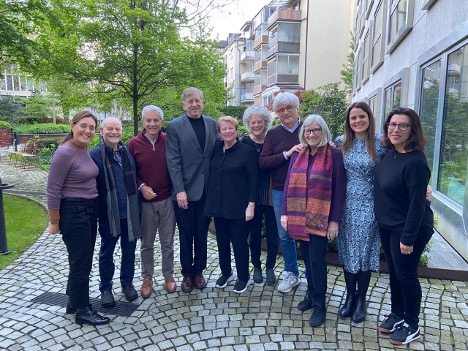
PEC members left to right are: Maria Cristina Vasconcellos (LA), Gary Grossman (NA) Alfredo Ortiz Fragola (LA), Richard Fritsch (Chair, NA), Majlis Winberg Salomosson, (EUR), Marsha Levy Warren, (NA), Giovanni Foresti (EUR), Angelika Staehle (Consultant, EUR), Liliana Castro (IPSO Representative), Sonia Wechsler (Asia Pacific).
Educational consultation
We provide consultation and guidance that makes use of our internal discussions. Within the structure of the Training Procedural Code, we apply principles of psychoanalytic education to help institutes solve complicated training issues on a case-by-case basis. This can include unusual training circumstances that need an objective outside perspective or the granting of an exception to the usual requirements. We also support institutes in developing and maintaining standards that are consistent with the IPA code.
Mandated by the Board in 2024, we consult with Institutes and review their plans for educating candidates who require extraordinary exceptions to the Procedural Code for training analyses and control analyses. This new task goes beyond simple approval or disapproval. We provide guidance towards creative efforts that support the four pillars of training for candidates who may need to have part of their training at a distance from the institute.
Inter-institute Peer review of training policies, procedures and philosophy: “MEETING OF SOCIETIES ON EDUCATION”
Meetings of Societies on Education (MOSE) provide opportunities for exchange among component societies. In each meeting, society leaders and candidates from three societies assess their educational philosophies, curriculum, and recruitment of candidates and teaching/consulting faculty.
Societies need this kind of forum for reviewing and enhancing their policies and procedures for educating psychoanalytic candidates. The initiative “Meetings of Societies on Education” was developed and implemented by the Psychoanalytic Education Committee. With the oversight function of PEC discontinued, it represents an innovative means of enhancing and increasing understanding and self-reflection within and among institutes through horizontally based exchanges. It is consistent with two elements of PEC’s mandate 1) Facilitate and improve the exchange of ideas and experience of education and training among all IPA institutes and societies; 2) To promote a process of reflection and self-study related to essential processes of education and training both within and between societies.
These meetings have been held regionally for the past four years. The European region has held 12 meetings that included 36 societies, the North America Region has held 6 meetings with 18 societies and the Latin American Region has held 6 meetings that included 18 societies, for a total of 72 societies from all over the IPA up to now. A meeting is planned for 3 Asia Pacific societies in 2025 and an interregional MOSE during the IPA pre-congress in Lisbon in 2025.
In North America, IPA Meetings of Societies on Education is co-sponsored by ApsA’s Center for Educational Encounters and Dialogue (CEED) under the leadership of Britt-Marie Shiller.
The goals of the encounters are 1) to exchange information about elements of training so that societies can learn from each other and importantly reflect on their own ways of organizing training and 2) to increase understanding of different training models and appreciate, when true, that different models can be employed to effectively and responsibility educate the next generation of psychoanalysts. This is especially important given the ongoing meaningful differences in approaches to training across regions in the IPA. These encounters help affiliated societies feel strengthened in their institutional identity thanks to their membership in the IPA.
The group meets usually for three hours on two consecutive days. Two members of the PEC facilitate the process. The work group consists of four or five representative administrative leaders, faculty, and candidates from each society. Societies introduce themselves to the group including history, training philosophy, orientation and important policies and procedures. These overviews yield considerable exchange among participants as the introductions are provided and show diverse ways of dealing with educational challenges. The facilitators then introduce aspects of the four pillars of psychoanalytic education (personal analysis, supervised clinical work, theoretical seminars and the support of the psychoanalytic community). The participants present positions, policies, procedures used in their societies and exchange with each other the advantages and limitations they have found with their local approaches. Facilitators monitor the group process so that all key areas are discussed while leaving room for the participants to focus on those elements that are most salient to them. A PEC member functions as a recorder of the event and provides a summary of the areas discussed and critical areas of agreement and difference.
This initiative has been very well received by all institutes who have participated. New ideas learned from other institutes have been implemented, problems associated with transgenerational traumas have been explored and understood. Variations in training among participants have been a source of curiosity and interest. We have found that while differences among training groups are present, there has been a striking absence of negative judgments between societies. The exchanges foster an appreciation of each group’s dedication to providing quality psychoanalytic education, maintaining standards and with strategies and practices that respond to local conditions.
Meeting of Societies on Education
Angelika Staehle - Meetings of Societies on Education Podcast
Webinar on Meetings of Society on Education
Directors of Training Exchanges
The PEC organizes an in-person meeting of Directors of Training (DOTs) at each international congress. A panel presents an important educational topic and the issues are discussed in large and small groups. The topic for Cartagena was Transgenerational Experiences of Tele-training. PEC also organizes a DOTs meeting on the off year between Congresses in a similar framework as the Congress meeting but in a virtual format. The topic for 2024 was Candidate Progression. These meetings provide the forum for constructive exchanges regarding different models and implementation strategies across regions.
Coordination with other Committees and Task Forces
The committee on Child and Adolescent Psychoanalysis (COCAP) and PEC work together to review and approve Integrated Training. We also collaborated with the two task forces that addressed virtual training (TF1 and TF2) as well as the Task Force on Collegial Quality Assessment. In all these efforts, PEC provides an educational perspective on the topic at hand.
Development of Principles of Psychoanalytic Training
In the context of many questions about the arbitrary nature of some training rules, PEC developed a set of guidelines based on principles rather than rules. These guidelines are meant as a supplement that institutes can use to monitor their own training standards
Principles of Psychoanalytic Education
Additional Links:
PEC Mandate